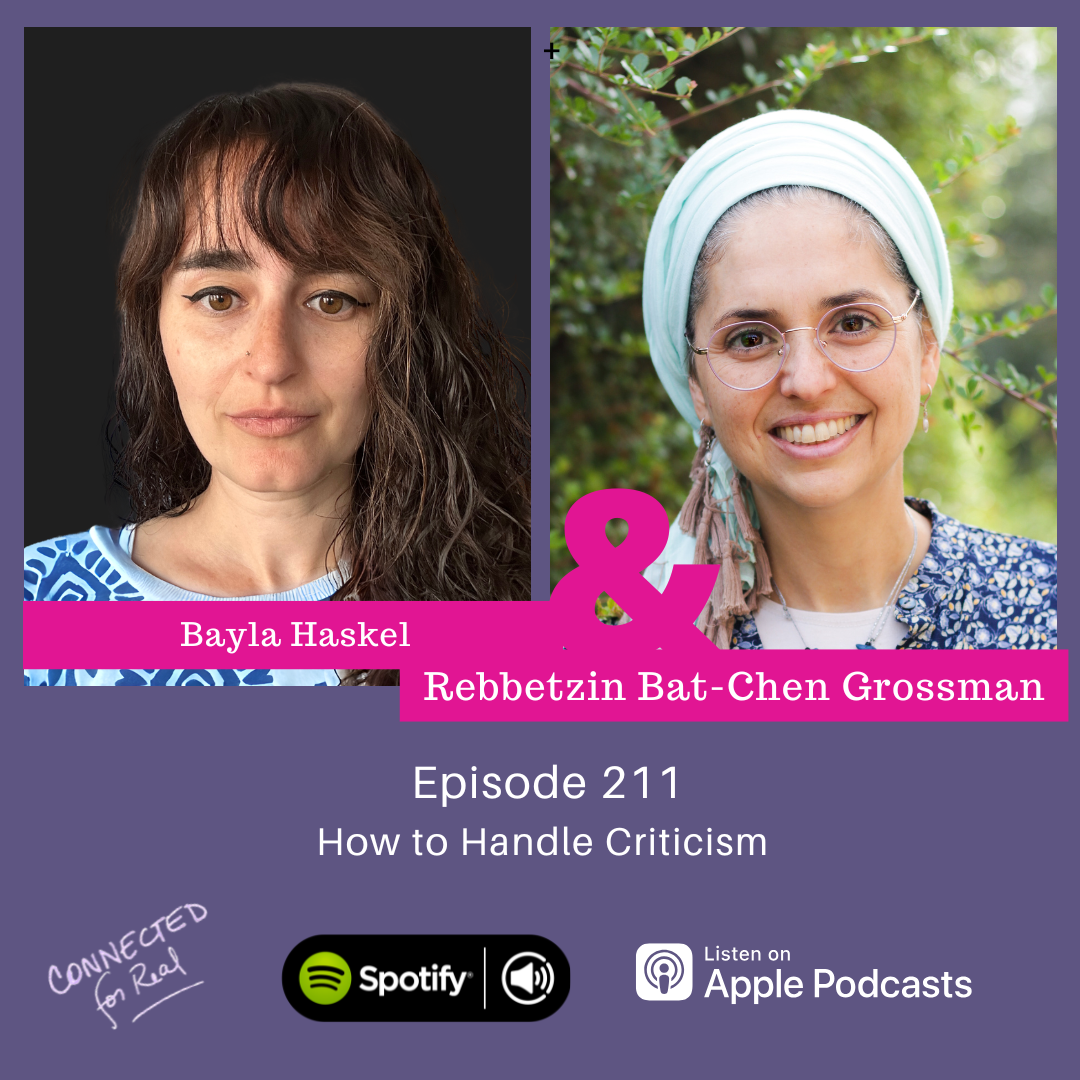

211. How to Handle Criticism
Connected For Real Podcast
| Bat-Chen Grossman | Rating 0 (0) (0) |
| connectedforreal.com | Launched: Nov 16, 2025 |
| advice@connectedforreal.com | Season: 6 Episode: 211 |
Bayla Haskel is a Product Manager in a High Tech Company in Tel Aviv and a mom of 4. Rebbetzin Bat-Chen Grossman is a marriage coach for women in business. Join them as they talk all about Criticism and Business.
Links:
Schedule a discovery call with me HERE
Get my free guide to Unravel Ovewhelm HERE
Find Bayla Haskel HERE
SUBSCRIBE

Episode Chapters
Bayla Haskel is a Product Manager in a High Tech Company in Tel Aviv and a mom of 4. Rebbetzin Bat-Chen Grossman is a marriage coach for women in business. Join them as they talk all about Criticism and Business.
Links:
Schedule a discovery call with me HERE
Get my free guide to Unravel Ovewhelm HERE
Find Bayla Haskel HERE
Bayla Haskel is a Product Manager in a High Tech Company in Tel Aviv and a mom of 4. Rebbetzin Bat-Chen Grossman is a marriage coach for women in business. Join them as they talk all about Criticism and Business.
Welcome to the Connected For Real podcast. I'm Rebbetzin Bat-Chen Grossman, a marriage coach for women in business. And my mission is to bring God's presence into your life, into your marriage and into your business. Let's get started.
And we are live. Welcome everyone to the Connected for Real podcast. I'm Rebbetzin Bat-Chen Grossman, and I'm a marriage coach for women in business. Today with me, I have Bayla and you're gonna introduce yourself in just a second, and then we'll get into our topic of criticism and business, which is so
interesting. So Bayla, introduce yourself. Yeah, so my name's Bayla Haskel. I live in GMO in Israel. I made around like 15 years ago. I have four kids. I've been married. For like 15 years, so maybe like 16 years ago. And I have been working in business. I have my MBA from Bar ilan. I had worked in high Tech right out of my MBA studies and I was working in Intel.
And then I eventually opened my own business called Veg it Out, which was incredible. And now I'm back in high tech. So just tell everyone what Veg Out was so that they can get a taste of it. And miss it just like I do. Yeah. Veg Out was a, first and foremost on like a bigger level was like a vegan food platform.
Like no judgment, just like really good food. Not telling anyone to be vegan, just like helping people love veggies more, which like, how could anyone be upset about that? I then started a meal delivery business for like working people. That was our main target market that had no time to cook for themselves, but like really wanted healthy, plant-based, not like overly processed foods.
And yeah, we were delivering outside of a kitchen of Raanana to basically all of Israel from Jerusalem to Natanya. And yeah, it was a great business and I loved it, but sadly had to close. And I went back to tech. Wow. So that's very cool. I remember it. I was always like drooling at the gorgeous, gorgeous pictures and videos of the food.
It is so cool how you can make regular vegetables look so good. Yeah. And, and they tasted good. I don't know. Like they also, I think that's important, right? Like when you go to a place for dessert and they send out these like, beautiful desserts and they're gorgeous and like, you know, it's not gonna taste good.
Because it looks so beautiful. So like, I believe, and my customers believed as well, that like that wasn't the case with us. I also was still creating content for a bit afterwards. Then October 7th happened and I. Was getting very involved in social media and all the stuff that was going on. And I like for my mental health.
I think like many people had to take a step back. But hopefully soon I, I'd like to go back to creating content under ve out, even if we're not selling a product and I'm working on a cookbook. While working on tech and doing all the other things, and hopefully it should come out by the end of the year.
It's been like two years by basically taking all the recipes that we were selling, all the bowls that we were selling to people and putting it in a cookbook and teaching everyone how to make them. So that's gonna be on Amazon soon. So really excited about that, that I'm looking forward to. That sounds really cool.
Okay, everybody listen up. By the time it comes out, we're all on it. Okay. It was so good. That's very cool. So I know you from there and I am excited that you're in and out of business and in and out of, you know, sort of like different points of view so that we can really talk about a lot of different I guess angles.
Yeah. And this month is all about criticism and specifically, so my business, let me just give you a little bit of a, you know, backtrack for all the people who are new or, you know, interested. My business is based on four pillars. So there's God at the core, marriage and business that work together. And then you are the container that holds all those parts of your life.
Mm-hmm. So, you know, when I say business, it doesn't have to be a business, but it's the thing that's. Pulling your attention that you feel is your purpose, that you're giving a lot of time to and makes you come alive. And some, you know, most times. And when I say marriage, you know, all the relationships, all the things that fall under that.
So really we're talking about all the things in your life, how they interact, how they sort of fall into place within your life, and how you can hold all that. So all that being said, my podcast is built like that. So we take one topic criticism in this case and we come at it from the different angles.
So criticism and god criticism and marriage criticism and business and criticism. And you. So this episode is criticism and business, but the topic is being talked about all month, which is really interesting. Let's talk about that a little bit. What comes up for you when we talk about criticism and business?
That's such a good question. I love that. It's like what comes up for you? 'cause as you were talking, I was like so many different things. I think I have a journey with this. I think I'm actually a great person to talk about this because I think like on the high level before we get into the deeper examples and things like that, I think business or what I did defined me like I was a good person or I was a purposeful person, or I.
Then criticism was much, much, much more painful. And when my business besides just my family was like the main thing that I was doing or contributing in the world was my job or like the thing that I was doing to make money, then criticism hurt much, much more because it literally was like questioning who I am, my being.
But I think in the last few years, definitely after a lot of therapy and I'm going through things and, and also what I went through with Veg it Out as well, that was probably the most time that the business was actually me, like my essence. So therefore the criticism there might've been even more painful.
And I feel like now I'm at a place where I have the job that I have and I have my family, but I'm also starting to do more things besides that. So I think the criticism is less crumbling or less impactful. I can take it and I can learn from it, or I can be like, okay, this is your. Thing, this criticism not coming to be constructive.
And I can put it to a side better. I'm definitely not perfect at it. It's still like something that's difficult for me. But I think I definitely had a journey with it and I think I'm in a better place where it won't, you know, be the most important thing that happened, that I'll remember every single word of the conversation.
So I think that's what came to me when we were talking about this. That's amazing. So let's get into the details a little bit. People are. Able to learn more from examples or stories for sure. What, what can you share? And feel free to share whatever works for you. Yeah, yeah, yeah. I've shared this story a lot of times now.
So like, you know, there's some things that happen that are hard in your life and the first time you're like, don't talk about it. It's super shameful. And then once you share it again and again, it becomes so, so there's something that happened before I did veg it out. I was actually, what was the catalyst that caused me to leave
the previous company that I was at to start veg it out. So it was probably a blessing wrapped up in something else. Mm-hmm. But I started working when I was 23. So like I said, right out of university. My first job was Intel and the second job was like a startup that was sort of like a break off of Intel.
It was a lot of like ex intel people. And while I was working there, I was 27, I guess. And just to be clear, I look back on myself and when I was 23 I was super confident and like I had experience in internships, but I didn't really have experience. Right. We always, hindsight is 2020, right?
I didn't, but to me, I, I know how to do all this and, when I was in Intel and then at this company, I was working with people that were like in their forties and I was in my early twenties or late twenties. And to me I was like just experienced as them. So like I definitely acted that way. So it probably did good to like be brought a few pegs down, but this wasn't like a few pegs.
This was like a, I'm gonna, you know, those cartoon hammers and like sled the ground. So this was a little bit much. A lot, much basically there was a saleswoman that was there and she was like gave me this whole speech and I had written down afterwards, like every word she said, so I would remember it.
So I would, I don't know, maybe I'm like a, I don't know why, to torture myself with all the leg harm things that she said to me. Um, But she basically was, you know, saying to me that like. I am a, you know, smart alec, not that exact word, the other word. And I like my reputation precedes me. And that when I was in Intel, she asked people about me when she was coming to work here and how like I leave dead bodies in my path and I'm like super ambitious at the extent of other people.
A again, I think I'm a more self-aware person now, hopefully. So, when I look back on it, it's not like I'm like, oh yeah, she was right. I was manipulative and I pushed people down. I, I don't think that was the case. I, no, I really do think that I was a young person and that I spoke my mind and that I probably didn't think about how like people that are older than me have more experience and how this might make them feel.
But you know, but you definitely weren't killing people and leaving their dead bodies around. No, I definitely wasn't killing people and I definitely don't think that I would find information about people and then get them to try. Like I wouldn't do things like that. I don't think that I was manipulative.
I definitely think I have a project. I would try to get it done. Maybe I wasn't self-aware enough, you know, I definitely could have done better to be more aware of my surroundings and be empathetic. But there was, it was a very harsh, you know, and like you will never be a good salesperson or you will never be.
And I remember asking like, well, what do you think? Right? I kept, I wanted to hear this also, like, I'm, I, I don't know why. Like, I wanted to hear the criticism Also I guess many of us are fascinated in understanding how other people see us. So like, I don't know, maybe it's just me. She was like, wow, I can't believe you're just taking this.
Like most people would call me. B word and then like be pissed off. And I was like, I don't know. It's important to grow. Mm-hmm. And I think in the moment also, you don't realize how painful it is until it like starts to seep in. Oh my gosh. That's so, and again, I think today when things happen and they're more painful and everything, I'm like, oh, this is, this is not.
Oh, you didn't realize we don't have that kind of relationship. Sorry, where I'm not gonna talk to you like this or talk about like about these things with you. I think then obviously again, youth, but also experience or whatever. Definitely. Definitely. Were in many situations where I don't think I understood that this thing.
Was gonna be very, very painful until after the fact. Right. And I remember asking her like, okay, so is there a book I could read? Is there something that I can do to like improve? And she's like, it just comes with experience. It's like when you're a parent, you don't like read parenting books and like become a better parent that way.
It's through experience and now like when I think back to that story again, whatever, I'm like, I've taken so many courses in parenting and I've read so many books in parenting and there's no way I would've been a good parent if I just left it up to experience. But again, like so we understand who we're talking about, but it's very much like.
It's experience. Also, I think the thing that was so painful in that point of criticism is the place where she was putting it down, like you said, like it was really with a hammer. Like she, she made it sound like there is no, there's nothing you can do about it. You're just totally messed up. You know, like, yeah.
Ouch. Yeah. Yeah. And I think that was hard is like I had, I had gone afterwards to like my manager and I, I think I, I eventually 'cause this things, this was like a big feedback session that I took and then it started becoming more, and I think at some point. We were also, like, we had gone on a business trip and we were talking to customers of ours and we were outside.
It was like we were selling to soccer teams, our app and we were outside and it was very sunny. It was like in the summer, and I don't know if you know, but soccer fields with like the fake grass, it could be like 27 degrees and it could feel like 40 degrees Celsius just because it's so hot.
It like absorbs. Yeah. The big grass is like plastic. It's, yeah. And I think I, I felt like I was about to faint, so I just sat on the side. Like we were in the middle of talking to a customer. She was talking most of the time and I was listening and learning and everything, and I, I sat on the side 'cause I felt.
I was gonna pass out. I didn't wanna make a big scene and everything, so I just, you know, moved to the side, drank some water and everything. And I think, again, I think that was triggering for her. I don't know, like maybe she thought I was being dramatic. I don't know. And she again, gave me this whole speech.
And I think at that point I was like, I started crying on like, not on purpose, but like letting myself cry. Which again, for me crying in a business setting was like never, that's like. No, you don't cry in business ever as a woman. Like that's, you're never allowed to, which I don't believe that's true anymore.
But that for me was like, for sure. And I remember I'm like, I feel very hurt. I'm going to cry now so she can see that this is hurting me. And maybe if she can see how painful this is. She'll stop. And I was crying while she's talking to me about it. And she kept going. I was telling you don't know what you're doing and you'll never be successful and you know the way you talk to people.
And she's like, well, Steve Jobs was, you know, arrogant and like nasty to people and he was successful. So maybe, maybe someday you'll be something, but like, I don't know. And I'm like the, I wanna be in a business setting, I'm working really hard at this, and the words that you're saying are really, really hurtful.
Like, I'm really hurt. Can you not see that I'm really, really hurt by the words that you're saying? She's like, well, you're just, you're so sensitive. You're just so, and it just became a thing. And it happened. She had start, like I had spoken to about a manager. I guess they spoke to her and she would come to my office.
She's like, I don't even know how to talk to you anymore. You're just. So sensitive, and it took me about a year and a half after this happened to leave. And, you know, if your daughter came and spoke to you about this or a friend came and spoke to you, like, I think I would be like, this is not healthy for you.
And I think the people in my setting, like my best friend, my husband, my mom. I think I was waiting for them to just say to me, like, leave. And I think kudos to them though that like, I think they wanted me to make the decision for myself because if I would've left that environment because someone else told me to, then maybe I wouldn't feel as sha them Right.
As whole as, yeah, sorry. As whole. And like by the time I left, it was like. I know what I'm doing. This is important. I need to move on from this place. It is toxic. Mm-hmm. It wasn't there before. It was really clear to me after two years, this is place is toxic for me and I need to move on. And that's how I started veg it out.
So. That's amazing. That's amazing. I think we can learn so much from this story. First of all, how to give criticism, like please stop if they're crying and like, don't, you know, don't make them feel like they're so small and so insignificant. They can't ever make it out, you know? And oh, maybe if you're. Like all these other people. And maybe, but no, but you know, it's just so painful, so please don't do that. But also it brings us to that place of, in business and in any setting really, there's always going to be somebody who's going to be critical, not because you did anything wrong.
Because this is what's coming up for them. And you said that before, and I wanna really bring that out here. I don't think you are calling the criticism, you know, I, I don't think you're doing anything to deserve it or whatever. There's a lot of times just it pops up. And this is something that you now have to deal with.
And like you said, in the end of the day, it pushed you to make a decision for yourself and, you know, find for yourself your worth and that you don't deserve this and it's not good for you. And, you know, it's a lot of wonderful blessings along the way, but, maybe we could talk about how we can make sure it doesn't hit so hard or it doesn't affect in such a hard way.
Yeah. Yeah. No, definitely. I think, you know, so many things in our life I don't believe are coincidence. I do believe from God. So like, it's so easy, right? When we're reading like a novel or a story, right? Like as we're reading the heroine going through different things, we're like, no, don't do this.
Why are you in a fight with him? Like, why don't you just, you should just know, right? What's his trauma? Like, you, you can watch the story and be like narrating it yourself and like. In our own lives when we're going through it, it's very difficult to see all those pieces, but then when we look back on it, we're like, oh, this is how all these things come together.
So I think for myself my father had just passed away from cancer like a year before this, like while I was still in Intel and I had started therapy around the same time. Because it was like a, it was cancer. It was a very, like, traumatic experience and that was something that. I had never been in therapy before my entire life.
And that was something that really pushed me to have to do something. And I was able to like during that time, work through these things also. And in some ways the. What happened to me, like my reactions after my father passed away and this were in some way connected, which is super bizarre.
But basically one of the things for me is that I did have sort of a disconnect with my emotions, definitely in the workplace, but in general in my life. 'cause it was like a survival method. Like this is how you get stuff done, this is how you reduce anxiety. Like, I don't think I was able to use those words, but sort of like.
You need to just move forward in life. And I think when my father was really sick and when he was passing away, and then when he passed away, I still, I had this as a survival method of this like disconnect. I'm not gonna feel the emotions and things going around it until my, you know, psyche was basically like, that's that's so funny that you think you're gonna suppress this.
We are going to push this up for you. So, I basically had to face this like, okay, we go through difficult things. And I'm not gonna push them down. And I think that was something with this, that I had to have had the tools to be able to do that. Like you had said before, this is hurting me and I can put down a boundary or like, this environment is not good for me.
I don't have to just fight through it and accept it. I can make a change. And I think that's something in therapy as well. And I think looking back on some of the things that she said, which weren't wrong, right? When people even give us like cruel criticism. There is truth to it, right? Like there could be truth to it, you know?
And I think part of the truth was that I think I'm a much more empathetic person now after I've gone through years of therapy. And because I could not suppress the difficult things, the hard things that happen to me, I could then see them for other people and feel 'em for other people and understand them and value them.
And I think that's part of the things that she was pointing out that, again, I don't think I really hurt other people, but I'm it is very possible that I were in situations that I just wasn't empathetic to what someone else was going through, and I just didn't see them well enough. Yeah. And it's so beautiful because you brought up a couple of times, I, you know, you don't cry in professional settings, you know, she gave me criticism and I naturally, or you know, subconsciously thought this is what I'm supposed to do.
Received it and said, yeah, what else? Tell me more. Because that's what you were taught was the right way to do something, right? Yeah. And that's such a. Amazing awareness and something that we really could talk about because all of us have these beliefs of how you're supposed to do something. And if you suppress your own emotions and just move them aside, you could be successful.
And really nowadays, we're becoming a lot more aware that nobody wants to be working with a faker or somebody who's too much of a, you know, professional facade. Yeah, it's not good for you and it's also not good for anybody you're working with the, you know, the, the people you're facing. That's what's coming up for me a little bit now too.
Yeah, for sure. Amazing. I also wanna give you like a ton of credit and, and clapping and like, good job for going to therapy. I know that. It's so helpful. So just, you know, as a little bit of background, my sister-in-law was killed a couple of months ago on her way to giving birth to her baby. So Tze'ela Gez and Ravid Chaim Hashem Yakom Damam.
And so that's my brother. And for us it was really, really. Obviously difficult. And one of the things that he said right away to everyone who came to visit, he is like, get help. Go to therapy. Do as much as you can to help yourself. Your brother said your brother said this? Yeah. He said Your brother just lost his wife.
Yes, yes. He was telling everyone this is something that she really stood for. She was a therapist. She used to treat people. She used to help people. And you can sit down with someone and go through a process and come out on the other end and not have to ever suffer. Again, you know, in this situation or in this type of thing, but instead you just are like, no, it's fine.
I'll figure it out myself. And you keep going and you keep moving and like 10 years later you're still frustrated at the same stuff and you're still like banging heads against walls. Like why just do it? So he was amazing. He was just like telling everyone, like, get help. This was a traumatic. Thing that happened to all of the nation, please everybody go get help.
And it was amazing. There was like all these pop-up, you know, therapists that knew her, that didn't know her, that were offering help to anyone who had anything come up for them. It was really, really very touching and very beautiful. And that's where it really hit home for me, how important it is to get help.
Especially when you feel like, okay, this thing just happened and like it hit me hard. Go and do it. You know? And there was also something that came up after her. Murder that we went, you know, 'cause I'm his sister, so she's my sister-in-law. I am not close enough to count as anything official, as silly as that sounds.
So if let's say I was her sister, it'd be different 'cause you know, they're close enough. Yeah. Thank God I'm very, very grateful that he's alive. 'cause he was shot too and he, thank God was fine. Gosh. And I'm very, very grateful for that. And also for his other three kids who are amazing and so beautiful.
And so, but like I'm not close enough to get anything from the government and so I was looking for ways to help my kids 'cause it's their aunt and, you know, everybody needs help. Right. And I, I showed up at the local place where they're giving kids therapy and I said, I want all my kids in therapy.
They said no. In situations like these, we wait for everything to settle and only those who really have a problem. Then we give them help and I was like, no, it's not. Wait, I don't wanna wait for the problem to come out. Like let's talk about it. No, and it's fresh and ready to like. You know, be released and not have to wait to see what effects it's gonna have on our lives.
Like, that just sounded crazy to me. And it turns out that this is something that she used to fight for a lot, you know, because she, that you didn't know that she was fighting for that before? No, I didn't. I, I knew that she was on her way to getting her PhD. She was already teaching therapists how to help their clients.
She was really, really. Amazing at working with women, with girls in, you know, her specialty was trauma. Ironically, of course. Hmm. And so like I knew that she did all these amazing things, but I did not know that the thing afterwards, like when it came up, my brother says this was the thing that she was fighting.
Everybody in the entire world of trauma was saying that first you have to let the dust settle and then you treat it. And she was screaming and yelling at everyone. No, treat it right away. 'cause if you can give them the tools, if you can give them the help right now, they won't have to suffer. Don't have to suffer.
They won't have to suffer. Yeah. And so yeah, I find that to be such an amazing piece of advice. And so I just wanted to take the time to like give you huge kudos for that. 'cause you just said for yourself, it changed your entire experience of how you have you. How you experience your emotions, how you're able to put down boundaries.
We were able, we went to couples therapy after because of it, like once we started that it was a snowball effect of everything. Yeah. 'cause once you see you can solve one thing, you're like, okay, all my other problems, let's take them all out. You could totally be like, this is totally, I've been looking at everything wrong.
We could totally fix this. No, it's really interesting 'cause also like with my siblings and things like that. I had just started therapy, so if I could go back in time, this is now 10 years ago. I'm 35 years old. I was 25 when this happened. Right. But I had a sibling that was like 13 at the time.
I don't know if he went to therapy or not, and I think all my siblings was based on like, if they wanted to or not. I definitely wouldn't have been able to say, oh, we should all be in therapy. But I think since I had gone and I'd seen all the things, I definitely recommended it, but I, I, you know, families are complicated.
We can't really push people to do things they don't want to. But I talk about it. And it's something with my husband as well, like. Couples therapy, right, was a stigma and we're both very private people, or I would say I used to be more of a private person. And now in cases like this, what we're talking about here, what I talked about, the criticism in therapy in general, I am much more willing to share personal aspects of this just because I strongly believe that.
People could get help and could improve and there's so much good work that can be done. But yeah, the couples therapy also, like I mention it to my siblings, I mention it to friends, and it seems like I'm just being so, like la about like, oh, you know, couples therapy, whatever. But it's like, no, if we talk about it and this is a thing that we just all do, it's a thing, then it'll just become a more of a norm.
So. Yeah. And you know, it just, it doesn't have to be called therapy or whatever, but like get, help, get, you know, those professionals who are out looking to help you. You know, like I know about myself, I love helping people. Yeah. So like for me, I'm a coach and I'm more than happy to, show up and help you reach your goals and, and work through stuff and whatever, but like you have to want it or be ready for it, or willing at least.
I think some of it like, because it was such a stigma before, right? And now it's becoming more of the norm. The way like I've described it to like either my mom or whoever I'm talking about it like, 'cause it feels like this, like in couples, sorry. For sure. It's like I don't like to exercise.
I think most people don't. There are people that love it, but like, I think, right? But like when you're exercising, it's like, I don't want to do this. This is so annoying. But then after you do it, you're like, oh my gosh. I have so much more energy. I'm so happy I did this, this was so important.
My muscles are aching and this is so painful and this hurts and this hurts, whatever. But like. I know a, in the long term, I can already see that I'm gonna have more energy, but I already feel great that I did it. And when I started picturing that while we were in couples therapy of like, it feels like that, like this, I don't wanna be here, I don't wanna open these things.
They're so hurtful and they're so painful and everything. But then after. It's like that same thing. And so I've described that as like, just like, you know, and so many business people, right? Like I think specifically people, business people like do exercise and are eating better, whatever. 'cause my mom's in business also.
In the us She has a clothing company and she's a CEO, she's very into her business, but like she always says you have to be in marathon shape. She's eight kids. So she's doing a lot all the time, right? So she's like, you have to be in marathon shape. So it's like, you know, for many business people or people that are working their own businesses or employees, it's like, of course I'm going to eat healthy.
Of course I'm gonna work out because I need to have longevity here. Like I need to be my best self. But therapy is still for many people like this. This, I don't know. It's not the thing, but I think you're eating healthy, you're working your body. You have to work your mind. It seems so clear now, but I don't think it would've been to myself before.
Hey, before we continue the episode, I want to ask you something. Are you ready to get answers from God directly, feel more in love with your husband and more supported than ever? Run the business of your dreams without having to sacrifice any other part of your life? That is exactly what my one-on-one private coaching is for, and I want to invite you, just you and me.
For a free deep dive discovery call, this is a 60 minute free call where I ask you lots of questions and we extract the three main things that are holding you back. I then put together a personalized plan for you where I create a roadmap of recommendations. With practical steps, the call is free and so valuable in itself.
So go book yours today. Now back to the show.
Right. Yeah. I think for me, I actually really see, you know, you have to be in, in marathon shape, so I see that as like. Spiritually, emotionally, you have to be journaling. You have to be aware of your thoughts. You have to be like, you know, really digging because if not, then the noise from the business world, the stuff that comes up
really gets in the way. Yeah, the journaling is really interesting. I probably have to do that more. I haven't gotten into that. I've done, like also meditation. I've tried to do that. Like I, I struggle with it. I know they're important. I do use chatgpt lot I think I'm using it less, but I was using a lot to like, work through things like at a situation in my current job where like, actually.
Thank God, like the place I work in now, I searched for it. Like I, I manifested it literally out of like thin air. I'd never heard of it before. And like I'd written down all the things that I wanted accompany and major points were like emotionally healthy people that open up when there are difficult things.
Like that was so important to me. So like the place where I'm in actually is excellent. Nowhere is perfect and everyone has to work on themselves and people have to work on themselves in business place, have to work on themselves, but like. From what I experienced till now, maybe at a low bar, like they're pretty amazing.
But it happened to be they'd brought in an employee and like it wasn't such a great thing. And we had a situation and they were definitely not emotionally healthy. So when I tried to bring up things, there was a lot of deflection, right? And like defensiveness and things like that.
So I was like, Ooh, this is, and I used chat, GPT actually. I actually copy and pasted conversations we had in from Slack, and I was like. Was I wrong here? Was I too tough? Like do, like, I was criticized for being like, I don't know, either obnoxious or I don't know what, like what I, I don't remember exactly what they said, so thank God I let it go.
The fact that I don't even remember the whole conversation means that I'm now able to let that go. But I put it into chat, GPT and I was like, can you help me analyze this? Like, should I have said something different? What do you think is going on for them? And it was actually a really helpful tool to reflect back.
Again, it's not foolproof. I don't think we should rely on AI for everything. But in the moment when I couldn't speak to my therapist, I wasn't gonna call a friend or my mom or my husband. It was like a good way to just reflect back to me like, okay, like maybe this, maybe that, but also then, and also this, and like, this is what you should do now.
And I think I, I can eventually get to journaling, but for now I'm, I'm using AI to talk about I think Chad. Yeah, I think Chad, GPT forces people to write. Their thoughts down, which is what journaling is pretty much about. Yeah. So if it's the way that you, you know, it's like a first baby step to writing down what you're thinking.
The translation of thought to paper is so powerful because then you can actually look at it and be like, oh, that's what I'm thinking. Oh, okay. Good to know. Because I thought I was thinking something else, you know? And a lot of times you look back at what you were thinking and you're like, Hmm, I'm not thinking that anymore.
I wonder why I was thinking that. You know? So it's really proud. You're, you're convincing me, I guess I have to do it. I feel like maybe I never did it. Or even now I'm like, am I actually gonna do it? It's like another thing that I have to like put on to do and be consistent with and whatever. But maybe I, like once in a while when I feel like it, I'm just, yeah.
So I have a journaling training in my program. And it's really very pressure less, you know, a lot of people are like, if, if you take on journaling, you better be doing it every day. Three pages a day, blah, blah, blah. You know, and always with the same pen and always in the same handwriting and it should be perfect then, you know, be, be indexed, you know?
I don't know what and when I realized that it does not work for me to do that, and I'm not gonna do it if I have to do it perfectly. 'cause I'm just too much of a perfectionist, ironically. I, I just let it all go and I do it whenever I want, however I want with whatever pen is there. And it's always changing handwritings 'cause my handwriting changes by how I feel.
And I journal in the middle of the night when I wake up to nurse or you know, in some random times that don't make sense. And like there is no rules. And that's just something that has taken away a lot of the pressure from journaling. Yeah. No, and I think when we're talking about, criticism, if we're bringing it back to the topic, no.
But like, I think that concept of journaling, like if I had that or something like that, even if I hadn't started therapy yet, I think the, like with many things, but I think what's so powerful about criticism, like why it could hurt us so much is because like when we're with our own thoughts in our head, like, we like exasperate the thing that the person said. Maybe we even like convince ourself like, oh yeah, that, that's, they must have said it. It must be true. My husband's reading a book now. It's like very well known, so you for sure know it. It's like the four has the plans on him, the four agreements. No.
By Gretchen Rubin before something or, yeah. I know what you're talking about now. It's very well known. Like, I don't know. People are like, I know it's well known. 'cause I see this all the time now. Oh yeah, yeah. I know what you're talking about. I could even see it in my head. Design before agreements. Yeah.
This one. Yeah, yeah, yeah. So he's reading it now, like I, I probably gonna read it. He just read me a part last night and he said, did have you read it? Have you read it yet? I read some of it. Okay. I didn't go through it. So there was one other thing. Again, I don't know what the four agreements are, so I don't know what the concepts of, excuse me, but there was a part in it that was saying how like we all have.
Maybe it's an agreement. I guess that's the, the term that is used in the book. But we have something that like we know about ourselves to be true. So let's say, I don't think this about myself, thank God, but like someone says to themselves like, I'm stupid. So now anything that they do is gonna either reaffirm or like, they're gonna make sure that it fits in.
So when they mess up, do something, whatever, it's like, I'm, I'm stupid. And they're probably gonna do things to reconfirm that to be true. Mm-hmm. And someone might do something. To question it, and then, you know, you're really smart and, and that might change everything. All of a sudden I might be like, am I smart?
Oh, okay. Like, let's see. All the times that I actually was smart, this person thought I was smart. And again, I, this is one page, I'm sure it's gonna get into it, but I, I think what's connected with that, I've, I've heard other ideas of like with a child, right? Like the voices that we have in our heads as adults, like what we tell ourselves.
Are the things that were said to us as children. So like we have to be very careful what we Right. That's why you never say you're a bad boy, you're stupid, whatever it is. But it's like those things are said to us and that's why everyone's very much into affirmations with children where like you are strong, you are smart.
Like it seems like maybe people don't think it's silly, but it's like we have the ability to give our children and ourselves. The voices that are gonna be with us in any given situation. If I take my car to get fixed, I have to get my wheels changed. I'm a woman and I'm small, and I'm short, and I have an American accent.
When I speak Hebrew, if I'm coming in with me, like, ugh, they're gonna take advantage of me. I'm so weak, I'm so small, whatever. And I'm gonna come in and be like, I know I'm small, but I am a very powerful person in a small package, and people underestimate me and I can get done the things that I need to get done.
So I'm gonna go. To that, you know, to the, to the, I'm gonna go to that place to get my wheels changed. And I'm gonna have confidence now because I know in other situations I get stuff done and I can get stuff done. But like, I think that's why criticism again, is, is, is important. But like you said in the beginning, we have to be very careful in the way we give it because it can.
We can ultimately be giving someone over the voice that's going to travel with them for the rest of their life and like, we can think about it with children for sure, but adults as well. Wow, that's so powerful. When we think about criticism like that. If we're the ones giving criticism to think my words might stick with someone forever, then we're gonna be a lot more careful about what we say and how we say it.
We're also going to be more in tune with are they able to hear it? And I think that's one of the things that's so powerful about criticism being given correctly, is can you be so aware that this is the right time, that this is the right situation that the person is ready and open to hear what you have to say.
And I think that was one of the things that the lady was so caught off guard. You know, going back to your story with the sales lady, it's like you were so chill externally that she was like, oh, I didn't realize she was this open to it. What's going on? Because I, you know. At first, I just thought I was like spewing criticism and she was gonna be upset and move away, you know, move along.
Maybe she didn't want it to upset me. Who knows? Yeah. Like people who are looking for drama might be subconsciously looking for drama and that that was probably, you know, something that she's all about. But it caught her by surprise. Like, could you imagine if you actually were questioning, like if you were able to put that boundary and be like, oh, this is hers.
She has issues, she has a drama thing. She's trying to hurt me. It's not, it's not hurting me. Like it's not I, I think it's interesting 'cause like, I think again, for those of us that have read parenting books and taken parenting courses or have just listened to other people that talk about parenting things, that concept of like not saying to children, you are.
You are, I think is the same thing for adults. I think it's for our spouses, I think it's for the people we work with that we have to criticism. Like, you know, you really should know, like you're really irresponsible and we need to work on that. Even if you say it in a nice tone and whatever it is that person is going to hear, I'm irresponsible.
And that's not gonna help them become more responsible because now that's their identity. I am irresponsible, right? So when I mess up and when I forget to do things. I'm irresponsible. So like what do you expect from me? Like it's also not good for the person. If you're managing that person, it's not good for you as well 'cause you're just reaffirming this thing that's difficult for you.
Right. I wanna just like, you know, you said don't say you are anything. So we're also not supposed to say, not supposed to, it's not something I usually use, but anything positive either because a lot of times. There's too much pressure being given. So like, you're so smart, you're such an artist, is like, oh my gosh.
So now from this moment on, I have to be this like, you know, high level smart. I know. Wait, can we talk about that for a second? I, there are schools of thought, right? Like there's a, they held on, made trauma in this, like, right. There are schools of thought here that are different. Some people are saying you don't do that to children.
Like if a child brings you the drawing that they did. You say like, wow, I see green there, I see black. That's, I don't know even what you say next, but like, but there are other schools of thought that you're supposed to give, words of affirmation. Like, I am smart, I am strong, I am powerful. I am, so, I'm actually not sure.
Yeah. So I actually what I learned and what I like is you call, you call it bite. You know, wow, that was some strength you had there. You know, like, this moment is a moment of strength or, you know, this is real art. Like, you're not, you know, maybe you don't see yourself as an artist, but this was real art and this is really beautiful.
So sort of like letting them create their affirmation based on the reality. On their actions, the situation. I, that's where I take it. That's where I, I know I wanna read up on it more because I do hear both, but like, because of this voice, there are so many negative voices walking around.
Like I want them to have these positive voices that are clearer that not just like, oh, one time I created something that was a work of art, but like, I am really good at drawing and like I'm a nice person and I'm a good friend and. I am talented and I don't know. And I, I think that what happens is that we create those, I am based on things that happen to us or that we do.
And so if somebody tells you, you are, you are, you are. So okay, that will stick. But like it's a much stronger place to be like, wow, I showed strength here and I. You know, created something artistic here and I was responsible here, like, wow, that's real responsibility. Well that means I'm responsible.
And then suddenly it's like, I think it's deeper and right. I think it's deeper and more powerful when it's something you. Collected and created for yourself. And I'll tell you something else from the other side of the story. I'm a good girl. I'm the oldest. I am, you know, peacemaker. I am always, always the best.
You know the best. I'm a good girl. And it really got in my wheels when I was doing my business, like when I was starting my business. Ooh. I had to do a lot of work on why I am not doing certain things because I'm a good girl and I have to follow everybody's advice and I'm gonna have to do it the way people say.
And what if I'm seeing a lot of different ways to do business, then like I can't go with the thing that feels the right thing for me because I'm supposed to be a good girl and follow all those steps and follow all the things, and like as soon as I give myself permission to like. I don't have to be anything, like, I don't have to be good.
I don't have to be bad. I just have to be myself. I need to do things the way it works for me. Suddenly I was like in, you know, following my intuition, doing the thing, and my business completely exploded in a good way. After I stopped being so hard on myself, like finding that. Like, it's so interesting, like that's okay.
So I'm gonna need to explore that a lot. But it's so fascinating. I feel like I don't know who I was. I think I was just talking about with my son. There's something really interesting. You're American originally, right? Obviously. Yeah. Okay. In America. I grew up in America. Okay. So, so myself as well. I've still been lived in America longer than I lived in Israel, but it's actually evening out in a few years.
Yeah, I think. I think I even doubt. Even doubt. Oh, okay. So I'm coming up. But I think what's so interesting is like as an American, and again, I know America's huge and it's different types of Americans, but like as a female. East coast, everything. Like I had very much had this like perception of like, I'm a good person and I need to be perceived as a good person.
And what does that mean? I need to be polite. Mm-hmm. And not hurt other people's feelings. And again, this is probably why that con, that criticism was so painful also, right? Like, I'm polite and, and then I come to Israel. People have chutzpah. Like, if I'm going to change my wheels and I'm gonna wait there on the side and wait for the guy to come up to me, no one's, no one's coming up to me.
I know now, after being here for 16 years, I'm gonna get in my car. I'm gonna be very, Hey, good morning, like thing. And I'm, oh, where's the owner of the place? Hey. Okay. Right. I'm gonna, I'm gonna come in, I'm gonna get in the space, I'm gonna make sure I'm seen, I'm gonna make sure I'm visible. I'm not gonna be rude, but I've had to work on the balance of like.
I am present and I'm here and I'm gonna take up space versus like, is it okay if I, if I, can I cut you in line? I only have one piece. Is that, do you mind? I won't do the, like, just cutting random people. Right? Like that still bothers me. I will never be afraid that, of course. I don't think anybody does that.
Especially not, you know. Thinking it's the right thing to do. I don't know if they realize, but I think that there's something interesting about being able to take like American and Israeli and balancing those things because I think, like I'm still trying to figure out, I don't know necessarily what the ideal is because there are some times when I feel like, because as Americans it's so important to be polite, we suppress.
So much. And then there are serial killers, like I know I'm being extreme, obviously, like it's way extreme, but like in Israel there are less sociopaths, like there are less serial killers. I don't know, is it connected? 'cause I feel like people here, you're driving on the road and you're in traffic and someone cuts you off and I will yell at them, they can't hear 'cause the windows are closed.
But I will get very, very upset. I might beep depending on what kind of car just cut me off. You know, how safe is it or not? But like. In some ways, like I get rage out, you know, someone's like parking diagonally and taking up two pots. I might yell and get really, like, what are they thinking? No one hears it, no one's in the car with me.
But like, I feel comfortable to let out my rage as opposed to like, as an American. So I, I'm just going back to this, these things that we tell ourselves, like I still don't know. Which way is better, but I'm trying, I'm sort of trying to figure out of like there's a, she, like there's a combination of something.
Yeah. But what you were saying about being true to yourself is that's, that's also hard because what is good for you might not be good for other people, but it's good for you. What's the line of like being selfish and narciss? So there, there's, oh, I love this. There's a training about assertiveness and so there's like the passive.
The aggressive. The passive aggressive. Yeah. And then assertive. And of course assertive is the one you wanna be in. So the passive is that like, oh, you know, it's fine. She caught me in line, whatever she probably needs to. And then the aggressive iss like, ah, I can't believe you've caught me in line. I'm gonna like, you know, scream at you forever.
And there's the passive aggressive, like, don't you know, excuse me, are you like in a rush or something? And like whatever. Semi nice, but really not. That's the worst. That's what just say it's the worst, and then assertive. We just say the facts like, excuse me, you went ahead of me and I was here first.
I'd like to pay now. And what you just did was you just stated facts and you stated your desire, you know, and it was so, it's so important to learn assertiveness because it respects everyone in the picture. Yeah. Now, maybe the person didn't realize they cut you off. Maybe you were invisible to them.
Maybe they were in their own head. Maybe they didn't realize, or maybe they just weren't taught to be nice and they just cut the line. But now that you put your foot down, they're not going to, you know. Yeah. And so by respecting your space and respecting them and not being like trying to pretend that you're anything other than what you really are, they know where you stand.
You know where you stand, and you can get your request in or your demand in and be really like respected there. So we're talking about learning to become assertive and there are real ways to do that. And you know. It's, it's really important too, and I think like we're talking about, like a lot of people throw all these fancy words like be authentic, be assertive, be whatever.
And it's like, what does that mean? So I think be authentic is be willing to be your true self even when it's not cool. Yeah, because that's really what it's all about, authenticity. Like people are not, you know, people look at me and say like, how could you not color your hair? You have all these white lines in your hair and blah, blah, blah.
And I'm like. Because this is who I am. I'm actually really happy 'cause I love it. You know when I'm not covering my hair, my hair is gorgeous. Has these like highlights of gray, everything else is dark. Like it is so funny that only in the front I got white. But like I always wanted highlights and I finally have highlights and they're natural, you know?
Do you know, like I always, when I was a kid, there would always be like, I don't know, in different commercials, they would always like the younger person, whatever, and they'd have this older woman and like she'd be beautiful and she'd have like gray hair, but like thick gray hair. And I was like, that's so gorgeous.
Like that's so amazing. So I was like, I'm sure your hair is gorgeous when it's open. It is so beautiful and nobody gets to see it, but I get to see it and I love it. And I'm not gonna color it just for someone else to be like. Happy and check off a, you know, check mark of like, I made other people happy.
Makes you, it makes you feel comfortable. Like this makes you uncomfortable. Okay. You're gonna have to deal with that. Exactly. But like, that's just such a tiny example of, well, you know, it brings us back to criticism. Yeah. Somebody can come and say something completely true. How could you walk around with so much gray hair?
Like, don't you have self-respect? Don't you know that you're supposed to look a certain way? I can't believe someone even said that to you. I don't believe that. Yes. Not only that. I gave someone a ride and she's in my car and she's telling me it's a stranger. Stranger. No. Like you know, I know her from places.
I don't actually like friends with her. She's not gonna hear this podcast. She might, no, probably not. Okay. Hopefully not. And she says, I can't believe it. I can't believe you're, you willing to like, let yourself go like that and whatever. And she gives me this whole speech and it we're talking about criticism.
So I'm like very open about this. Very, very critical. And I just said, thank you so much. But I actually really love it and I'm not gonna color it. She's like, you really should. You know, you really should. And I'm like, why? You tell me why? So this is, this is authenticity, right? Like if we're talking like, can we break it down and give people permission to be themselves?
That's authenticity. Or like. I love wearing unmatched socks, not because it's my style, but because I'm a mother of eight children, I could not care less if the socks are matching as long as they feel the same. So I will just pick the ones that make me most happy from the pile and just walk away. My kids, they try to like pair them and they whatever.
I could not care less. Like I do not have time in my life to sit around and look for pair in the morning. Yeah. Especially not in the winter when I need your, you also just get one color of socks. But like if Yeah, I know. So, you know, basically what I did was I got a bunch of really colorful, fun socks.
Yeah. And they're all the same material and they, they the same feel, but they don't always match. I think that's a thing now. No, I think that's a, like, it's a trend now to like, not, of course, it's, I started it. Yeah, of course. Just kidding. No, I do know that people people go out of their way to buy fancy.
Un paired socks. And I told my kids that, I'm like, you should know, by the way, this is like a total cool thing to do. Yeah. But anyway, so, so I was, I'm meeting now. I'm so sorry. I have a meeting now. What time are we supposed to go till? Oh, yeah, yeah, yeah. Until now. Okay. So anyway, let's just wrap it up.
Yeah, yeah, yeah. Of course, of course, of course. How can people find you? Where do you want them to be following you? I'm still on Instagram, I'm not going on as actively, but definitely follow me@vegout.com. So vg.it, dot out at like on Instagram. So yeah, we're gonna put all your links down below and everybody will be able to find.
So that would be the, like the main place. And I'll be back soon with the cookbook, but I'm like working on while I'm working full time for kids and you know, all the things, but. Take your time. We're ready for it. We're excited. I know, I know. Thanks so much for being with us. Sorry guys for like the abrupt ending, but yeah, sorry about that.
I just realized I lost track of time, which is totally authentic of me. That means we were having fun, so we were totally, I, I like, I really, I had an alarm, so that's the only reason why I have alarms for each meeting that I'm gonna have. Otherwise, I just wouldn't get to any meeting. There you go. So yeah, I have that too.
But, you know thank you so much to everyone for listening. Don't forget to be connected for real, and I will see you next time. And thank you, Bayla.
And that's it! Thank you for listening to the very end. I would love if you can leave a review and subscribe to the podcast. Those are things that tell the algorithm this is a good podcast and make sure to suggest it to others. Wouldn't it be amazing if more people became more connected for real? And now take a moment and think of someone who might benefit from this episode.
Can you share it with them? I am Rebbetzin Bat-Chen Grossman from connectedforreal. com. Thank you so much for listening and don't forget you can be connected for real.